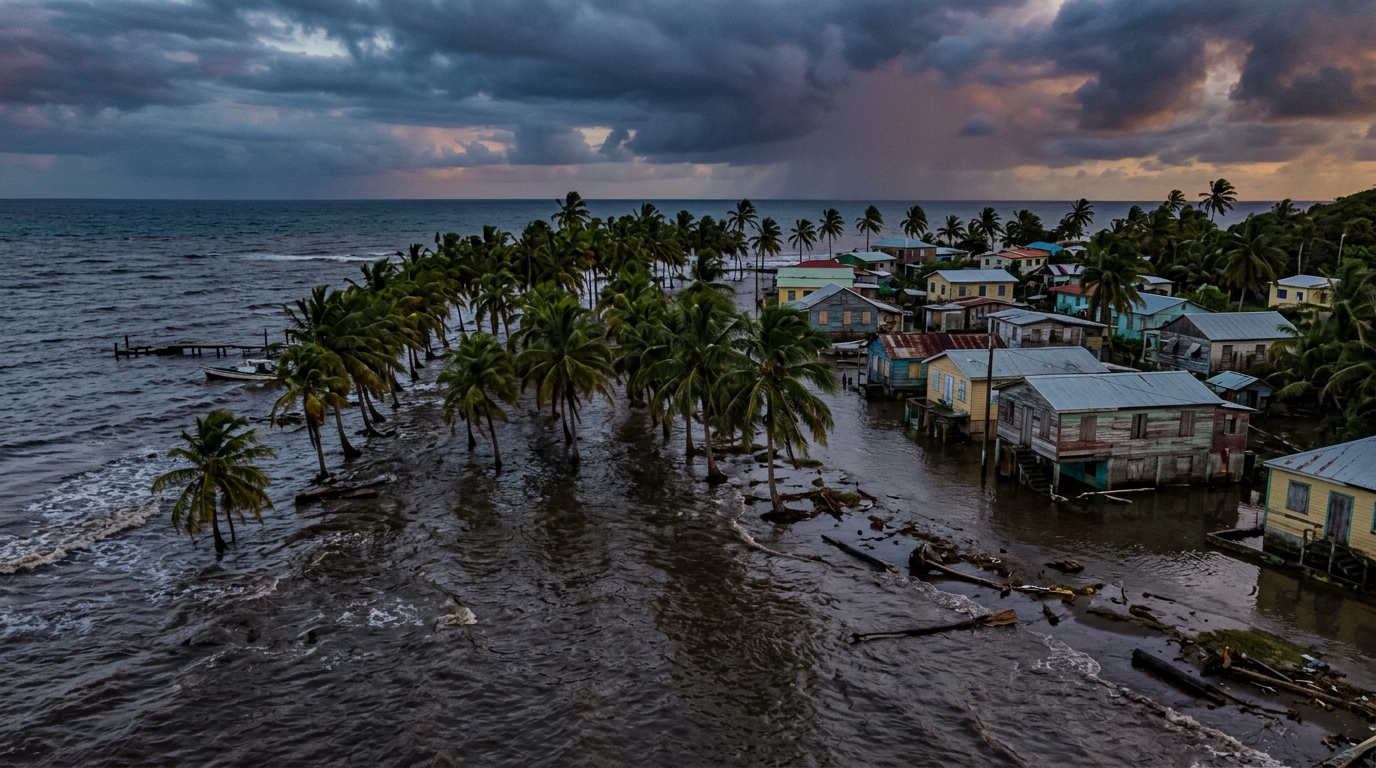
The Caribbean region is one of the most climate-vulnerable areas on the planet. Small island developing states (SIDS) face existential threats from rising sea levels, increased hurricane intensity, prolonged droughts, and coral reef degradation. These environmental changes are not only ecological challenges — they are powerful drivers of human migration, displacement, and planned relocation that will reshape Caribbean demographics over the coming decades.
Climate projections indicate that the Caribbean could experience sea level rise of 0.5 to 1.5 metres by 2100, directly threatening coastal communities across every island territory. Low-lying areas in the Bahamas, Belize, Guyana, and Suriname face the prospect of becoming uninhabitable. Category 4 and 5 hurricanes, once rare, are becoming more frequent — a trend starkly demonstrated by the catastrophic impacts of Hurricanes Irma and Maria in 2017, which displaced hundreds of thousands of people and caused over $100 billion in damages across the Lesser Antilles.
Environmental migration in the Caribbean takes two primary forms. Sudden-onset events — hurricanes, floods, and volcanic eruptions — cause immediate displacement that can last days, months, or become permanent. Following Hurricane Maria, Dominica lost an estimated 90% of its infrastructure; thousands of Dominicans migrated to other islands or to the United States, with many never returning. Montserrat experienced a different kind of forced relocation when the Soufrière Hills volcano erupted in 1995, displacing the majority of the island's population — many permanently.
Slow-onset changes — saltwater intrusion into freshwater aquifers, coastal erosion, agricultural disruption from shifting rainfall patterns — are less visible but equally destabilizing. Farmers in Jamaica, Trinidad, and Barbados report declining yields, unpredictable growing seasons, and increasing water stress that are eroding the economic foundations that keep rural communities viable.
Several Caribbean governments are exploring planned relocation — the structured, government-led movement of communities away from high-risk areas — as a long-term adaptation strategy. This is an enormously complex undertaking that involves legal, social, cultural, and economic dimensions. Communities that have lived in coastal areas for generations resist relocation, and poorly designed programs risk destroying social cohesion and cultural identity.
The CMC Environmental Migration Network works to build the evidence base for dignified, rights-respecting relocation and to develop frameworks that protect the rights of environmentally displaced persons. Unlike refugees, those displaced by environmental change have no dedicated international protection regime — a gap that the network actively seeks to address through advocacy and policy development.
Not all environmental migration is forced or negative. When supported by appropriate policies, migration can serve as a legitimate adaptation strategy — allowing people to move away from high-risk areas, diversify household income through remittances, and maintain links with origin communities. The challenge is ensuring that migration is a choice rather than a desperate last resort, and that communities left behind are not further marginalized.
The CMC network brings together climate scientists, migration specialists, government planners, and community representatives to develop policy frameworks that treat migration as one component of a comprehensive climate adaptation strategy, ensuring that the dignity and rights of those who move — or choose to stay — are protected.